Tag - tokyo

Japanese art

I recently spent a week in Japan and while there had the opportunity to visit the national gallery in Ueno park, in Tokyo.

The visit was wonderful and I had the chance to see amazing 500-year-old pottery from all over Asia, including this Ming bowl. That, of course, was one of the younger pieces as the gallery has many older pieces, including this incredible 400-year-old jar from the Manjiayoo culture of ancient China:

After touring the Asian sections of the gallery, I went to the Japanese art section, featuring paintings on huge screens or panels – where I was not allowed to take photos. This was fascinating and enjoyable, but … confusing.

I’m used to Western art. While I’m not an expert by any means whatsoever, I can “read” it to a degree … understand it … appreciate it. Japanese painting, on the other hand is very different … in many ways I cannot read it and do not understand it.

Japanese art, especially traditional Japanese art, seems to almost be more about what is not there than what is. In my limited understanding, this does not appear to be negative space in the western architectural sense, though. Rather, the landscape and objects that are not there are not omissions – they are not removed. Rather, my sense of it is that it’s more of a fading away … a merging with the background which is not background but is also foreground.

Later Japanese art from the 20th and 21st centuries seems more detailed, more western. It employs more tricks of perspective to spatially place objects and scenes in a more “realistic” way. It’s more accessible to my Western eye.

Perhaps next time I go to Japan (if I go) I’ll read up on traditional Japanese art and be able to understand it better.

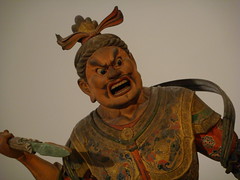
I did notice, however, that other sections of Japanese art, including sculpture and carving, were far more accessible – though I’m certain that I’m missing many things when viewing these as well.
Japan!

I’m sitting in my hotel room on the 30th floor of the Ritz-Carlton in Osaka at 5:35 AM, Sunday morning, reflecting on my Japan experience so far.

Club downFirst impressions are only first, and I have 5 days in Tokyo to add to them, but they tend to last. My first impression is that Japan is by far the most foreign place I have ever visited – foreign in the sense of profoundly different, unknown, out of my experience, and even potentially unknowable.

I’m no Marco Polo, but I’ve been to Romania, many countries in Western Europe, Northern Africa (Egypt), mainland China, Taiwan, and all over the US and Canada. So I’m not unfamiliar with being in places where few if any speak my native language. And it’s not unusual for me to be an ethnic minority when I travel. But there’s something about the incredibly different language, the different characters/letters, and the different social customs that just make Japan qualitatively different.

More than that, there’s something about the monoculture of Japan – those are the words of a native Japanese from a talk at the ACE 2009 conference yesterday – that make Japan the most foreign place I have traveled. I’m used to being the only white guy in a room or a train station. But it’s outside of my experience to hardly see a black person, an Indian, or even different Asian ethnicities.

Evil Budda?Add it all up, and you have countless experiences that your brain just can’t interpret … can’t file away in the right slot … can’t process and understand.

For example, I walked into a shop a couple of days ago, my first day in Osaka, and I could not determine what the store sold. Imagine that – being in a store and not being able to understand what was actually for sale! There were obviously products available for purchase, with price tags, and product information, and people paying, and a cashier – all the familiar archetypes of “store” from my Western, Canadian experience. But the products appeared to be small pieces of paper, or cards – about business card sized. Japanese women shave?They weren’t phone cards, weren’t sports trading cards … and I could not determine what precisely, they might be. Nor could I and the salesperson communicate.

The experience – just one of many similar – stretches your brain’s expectation engine and challenges your ability to understand, predict, and therefore feel a (false) sense of control that tends to put you at ease. So in Japan I am always wandering and wondering: what is this? is it what it seems? is that person speaking heatedly to another angry, or just speaking normally for Japanese? what is this building for? is “arigato” (Harry without the H, French for cake – gateau – with a long O at the end) OK for thanks, or is it too familiar?

Being a complete naif and newbie in Japan means that I can somewhat safely wander around like a medieval village idiot: investigating the obvious, pursuing the mundane, and capturing a gestalt of “japan-ness,” or, to be more honest, “my Japan,” the Japan that I hazily grasp.

Hope you've got good aim!The beautiful and glorious thing about travel like this, of course, is the ability to step out of MY mundane, and MY obvious, and pass through the wormhole to an alien culture and learn and re-learn the world anew. Here I am alien – even gaijin – and therefore I have the freedom of the outsider to observe and see, and the curse of the outsider to always be on the fringe. It is strange and exhilarating and enjoyable and challenging. And it’s also exhausting.

But I wouldn’t miss it for the world.

Prepping for Tokyo, Osaka … what else?

I just bought the tickets and confirmed: I’m heading to Japan in October.

So far, I know 3 things:

  1. I’m going to land in Tokyo
  2. I’m going to be in Osaka on the 24th and 25th speaking at ACE 2009
  3. I’m going to fly out of Tokyo

The question is: what else should I do?

Should I try to visit Mount Fuji? How far is it from Tokyo … and how much time would it take to climb? Should I spent all my time in Tokyo – in a city of 12 million or more there’s got to be plenty to do. Questions, questions, questions!

I’ll be researching this in the next week or so – any suggestions would be much appreciated!

Subscribe to my Substack